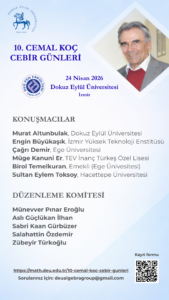
On April 24, 2026 the 10th Cemal Koç Algebra Days workshop will be held. For more information and registration, see the workshop page: https://math.deu.edu.tr/10-cemal-koc-cebir-gunleri/
On April 24, 2026 the 10th Cemal Koç Algebra Days workshop will be held. For more information and registration, see the workshop page: https://math.deu.edu.tr/10-cemal-koc-cebir-gunleri/
Ulusal Matematik Sempozyumlarının 34’üncüsü, Türk Matematik Derneğinin desteği ile Dokuz Eylül Üniversitesi Matematik Bölümünde, 31 Ağustos-3 Eylül 2022 tarihleri arasında yüzyüze gerçekleştirilecektir. 1988 yılından beri gerçekleştirilen Ulusal Matematik Sempozyumlarının programı, genel konuşma, çağrılı ana konuşmalar, dizi konuşmalar ve genç araştırmacı konuşmaları, kısa konuşmalar ve poster sunumlarından oluşmaktadır.
İzmir’in kurtuluşunun 100. yılında sizleri ağırlamaktan gurur ve mutluluk duyacağız.
Workshop webpage: http://img.deu.edu.tr/en/
One of two aims of İzmir Mathematics Days is to provide a platform for graduate students to share their works, ideas and experiences and to build research and mentoring networks. The other one is to encourage undergraduate math majors to pursue a career in Mathematics.
In the morning sessions, four colloquium talks will be given by the invited speakers to introduce their research of interests. The afternoon sessions are devoted to graduate students and young researchers. All students are welcome to apply.
Due to COVID-19 pandemic, the workshop will be held ONLINE.
All abstracts must be same language with talk. The talk can be either in English or in Turkish but this must be clearly stated in the submission process.
Ali Sinan Sertöz (Bilkent University)
Fatma Altunbulak Aksu (Mimar Sinan Fine Arts University)
Kağan Kurşungöz (Sabancı University)
Münevver Tezer (Middle East Technical University)
Place: Dokuz Eylül University, Mathematics Department, B256
Date: 8 November 2019
Our workshop is supported by TMD (MAD). We are grateful to them for this support.
Invited speakers
Ahmet Muhtar Güloğlu, İ. D. Bilkent Üniversitesi
Faruk Temur, İzmir Yüksek Teknoloji Enstitüsü
Emrah Sercan Yılmaz, Boğaziçi Üniversitesi
Program
10:00—10:30: Welcome coffee break
10:30—11:45: Faruk Temur
11:45—13:30: Lunch break
13:30—14:45: Ahmet Muhtar Güloğlu
14:45—15:15: Coffee break
15:15—16:30: Emrah Sercan Yılmaz
Abstracts and details:
http://math.deu.edu.tr/wp-content/uploads/2019/10/arit-izmir3-program.pdf
Workshop webpage: http://img.deu.edu.tr/en/
One of two aims of İzmir Mathematics Days is to provide a platform for graduate students to share their work, ideas and experiences and to build research and mentoring networks. The other one is to encourage undergraduate math majors to pursue a career in Mathematics.
In the morning sessions, four colloquium talks will be given by the invited speakers to introduce their research of interests. The afternoon sessions are devoted to graduate students and young researchers. All students are welcome to apply. There will also be an informative panel of faculty members describing the graduate program at DEU followed by Q&A session.
All abstracts must be submitted in English. The talk can be either English or Turkish but this must be clearly stated in the submission process.
Yusuf Civan ( Süleyman Demirel University )
Title: A short tour in combinatorics
Abstract: This is an invitatory talk to a short trip through the jungle of combinatorics, one of the fascinating fields of modern mathematics. If time permits, we plan to visit various sites in the jungle, including those from combinatorial number theory to discrete geometry, graph theory to combinatorial commutative algebra, etc. Lastly, after showing our respect to the founder king “Paul Erdös” of the jungle, we review the current status of some of his favorite open problems.
Konstantinos Kalimeris ( University of Cambridge )
Title: Water waves – Two asymptotic approaches
Abstract: TBA
Müge Kanuni Er ( Düzce University )
Title: Mad Vet…
Abstract: How does a recreational problem “Mad Vet” links to interesting and interdisciplinary mathematical research “Leavitt path algebras” in algebra and “Graph C*-algebras” in analysis.
We will give a survey of the last 15 years of research done in a particular example of non-commutative rings flourishing from the fact that free modules over some non-commutative rings can have two bases with different cardinality. Surprisingly enough not only non-commutative ring theorists, but also C*-algebraists gather together to advance the work done. The interplay between the topics stimulate interest and many proof techniques and tools are used from symbolic dynamics, ergodic theory, homology, K-theory and functional analysis. Many papers have been published on this structure, so called Leavitt path algebras, which is constructed on a directed graph.
Haydar Göral ( Dokuz Eylül University )
Title: Arithmetic Progressions
Abstract: A sequence whose consecutive terms have the same difference is called an arithmetic progression. For example, even integers form an infinite arithmetic progression. An arithmetic progression can also be finite. For instance, 5, 9, 13, 17 is an arithmetic progression of length 4. Finding long arithmetic progressions in certain subsets of integers is at the centre of mathematics in the last century. In his seminal work, Szemerédi (1975) proved that if A is a subset of positive integers with positive upper density, then A contains arbitrarily long arithmetic progressions. With this result, Szemerédi proved the long standing conjecture of Erdős and Turan. Another recent remarkable result was obtained by Green and Tao in 2005: The set of prime numbers contains arbitrarily long arithmetic progressions. In this talk, we will survey these results and some ideas behind them.
Place: Dokuz Eylül University, Mathematics Department, B256
Date: 10 May 2019
Our workshop is supported by TMD (MAD). We are grateful to them for this support.
Deadline for application is 2 May 2019
Application form click
Invited speakers
Ali Ulaş Özgür Kişisel, Middle East Technical University
Ayberk Zeytin, Galatasaray University
Ekin Özman, Boğaziçi University
Yıldırım Akbal, Atılım University
Program
9:15—9:30: Opening
9:30—10:45: Ali Ulaş Özgür Kişisel
10:45—11:15: Coffee break
11:15—12:30: Ekin Özman
12:30—14:30: Öğle arası
14:30—15:45: Yıldırım Akbal
15:45—16:15: Coffee break
16:15—17:30: Ayberk Zeytin
Ali Ulaş Özgür Kişisel, Middle East Technical University
Title: Line Arrangements Over Different Base Fields
Abstract: There are various obstructions regarding the existence of line arrangements in the projective plane over a given base field. In this talk, some of these obstructions and how they depend on the chosen base field will be explained.
Ekin Özman, Boğaziçi University
Title: Modularity, rational points and Diophantine Equations
Abstract: Understanding solutions of Diophantine equations over rationals or more generally over any number field is one of the main problems of number theory. One of the most spectacular recent achievement in this area is the proof of Fermat’s last theorem by Wiles. By the help of the modular techniques used in this proof and its generalizations it is possible to solve other Diophantine equations too. Understanding quadratic points on the classical modular curve or rational points on its twists play a central role in this approach. In this talk, I will summarize the modular method and mention some recent results about points on modular curves. This is joint work with Samir Siksek.
Yıldırım Akbal, Atılım University
Title: Waring’s Problem, Exponential Sums and Vinogradov’s Mean Value Theorem
Abstract: Having introduced Hardy&Littlewood Circle method, we will jump to Waring’s Problem: representability of a large integer as the sum of s kth powers of positive integers, which was the main motivation of Vinogradov to study a system equations (called Vinogradov’s system). Next we move on Vinogradov’s mean value theorem: a non-trivial upper-bound on the number of solutions to Vinogradov’s system, and then mention the milestone contributions of Vinogradov, Wooley and Bourgain (rip) et al.
Last but not least, some applications of Vinogradov’s mean value theorem on exponential sums will be given.
Ayberk Zeytin, Galatasaray University
Title: Arithmetic of Subgroups of PSL2(Z)
Abstract: The purpose of the talk is to introduce certain arithmetic questions from a combinatorial viewpoint. The fundamental object is the category of subgroups of the modular group and its generalizations. I will try to present the different nature of arithmetic of subgroups of finite and infinite index and their relationship to classical problems. I plan to formulate specific questions at the very end of the presentation and, if time permits, our contribution to both worlds.
This is partly joint with M. Uludag

It is our pleasure to invite you to participate in “The 9th International Workshop on Differential Equations and Applications” which will be organized by Department of Mathematics of both Dokuz Eylül University and Yeditepe University and held in Doğa Holiday Village, İstanbul on May 24-26, 2019. The scope of the conference is to bring together members of the mathematical community whose interest lies in applied mathematics to assess new developments, ideas and methods. The conference will cover a wide range of topics of
and all other fields of applied mathematics.
Workshop website: http://wdea2019.deu.edu.tr
Prof. Dr. Metin Gürses (Bilkent University)
Prof. Dr. A. Okay Çelebi (Yeditepe University)
Prof. Dr. Hüsnü Ata Erbay (Özyeğin University)
Prof. Dr. Varga Kalantarov (Koç University)
Prof. Dr. Maciej Blaszak (Adam Mickiewicz University)
Prof. Dr. Mieczysław Cichoń (Adam Mickiewicz University)
Prof. Dr. Wen-Xiu Ma (University of South Florida)
Prof. Dr. H. Mete Soner (Swiss Federal Institute of Technology)
Prof. Dr. Ayşe Hümeyra Bilge (Kadir Has University)
Prof. Dr. Albert Erkip (Sabancı University)
Prof. Dr. Oktay Pashaev (İzmir Institute of Technology)
Prof. Dr. İsmagil Habibullin (Russian Academy of Sciences)
Prof. Dr. Alp Eden (Boğaziçi University)
Assoc. Prof. Dr. Burcu Silindir Yantır (Dokuz Eylül University)
Asst. Prof. Dr. Meltem Adıyaman (Dokuz Eylül University)
Asst. Prof. Dr. Gülter Budakçı (Dokuz Eylül University)
Assoc. Prof. Dr. Ahmet Yantır (Yaşar University)
Assoc. Prof. Dr. Aslı Pekcan (Hacettepe University)
The goal of the workshop is to bring together the researchers from the fields of Algebraic Topology and Applied Topology in Turkey to discuss their field of interests and to initiate new collabrations for future research projects.
The morning session will be held at Room B256, Department of Mathematics and the afternoon session will be held at Room B258, Department of Mathematics. For more information, send an e-mail to asli.ilhan at .deu.edu.tr.
Program
| 10:00-11:00 | Ayşe Borat |
|---|---|
| 11:00-11:20 | Coffee Break |
| 11:20-12:10 | Matthew Gelvin |
| 12:10-14:00 | Lunch |
| 14:00-14:50 | Mehmet Akif Erdal |
| 14:50-15:00 | Coffee Break |
| 15:00-15:50 | Hanife Varlı |
| 15:50-16:00 | Coffee Break |
| 16:00-16:30 | Sabri Kaan Gürbüzer |
| 16:30-16:40 | Coffee Break |
| 16:40-17:10 | Derya Bayrıl Aykut |
Topological robotics is a field initiated by Michael Farber in 2003. This new field tries to answer topological questions which are inspired by robotics and engineering. In this talk, we will give a brief survey in topological robotics mainly focusing on an important homotopy invariant called Topological Complexity which measures how far a space away from admitting a motion planning algorithm.
The Euler characteristic of a simplicial complex is a well-known and important combinatorial invariant. When considering small categories and their geometric realizations, one might hope that there is a similar invariant, ideally one that generalizes the classical Euler characteristic in the case of posets. Leinster defined such an object and proved some of its basic properties.
In this talk, I will outline Leinster’s notion of the Euler characteristic of a category and describe how it was used in joint work with Jesper Møller to guide our search for objects that control the homotopy type of certain categories that arise in the study of p-local finite groups.
Fibration categories, as introduced by Brown [1], provide convenient models for homotopy theories as weaker alternatives to model categories. In this talk we will discuss fibration category structures that are induced by enrichments in symmetric monoidal model categories. We will also show that various categories of operator algebras, including Schocket and Uuye’s homotopy theory for $C^*$-algebras [4,5], and their equivariant versions are examples of fibration categories induced by enrichments. By using this, we recover known results that equivariant $KK$-theories and $E$-theories are triangulated categories (see [2,3]).
The primary concern of Morse theory is the relation between spaces and functions. The center of interest lies in how the critical points of a function defined on a space affect the topological shape of the space and conversely. Discrete Morse theory, developed by Robin Forman, is a discrete version of Morse theory that turned out to be also an efficient method to study of the topology of the discrete objects such as simplicial and cellular complexes.
In this talk, we will briefly mention smooth Morse theory, then talk about discrete Morse theory. In particular, we will talk about perfect discrete Morse functions, and the problem of composing and decomposing perfect discrete Morse functions on the connected sum of triangulated manifolds.
In this talk, we will introduce some simplicial properties of the set of planar binary trees and a decomposition of the bicomplex into vertical towers given Frabetti [1].
A spatial displacement is a composition of a spatial rotation followed by a spatial translation. There is an invariant line of these transformations, called screw axis. In this talk we will mention about velocity analaysis of a general spatial motion.