Cardano’s Formula and Casus Irreducibilis

Çağdaş Çiğdemoğlu, Dokuz Eylül University. Date: 18th of December, 2024, Wednesday, Time: 15.00 – 16.00. Place: Dokuz Eylül Univ., Tınaztepe Campus, Faculty of Science, Department of Mathematics, Classroom B255.

Abstract: We will start with a general monic cubic equation in the form

    \[ x^3 + bx^2 + cx + d = 0, \]

and transform it into the following form

    \[ y^3 + py + q = 0, \]

using a substitution. Then, we will construct the Cardano Formulas to find the roots of the equation. The roots are expressed as follows:

    \[ y_1 = \sqrt[3]{\frac{-q + \sqrt{q^2 + \frac{4p^3}{27}}}{2}} + \sqrt[3]{\frac{-q - \sqrt{q^2 + \frac{4p^3}{27}}}{2}}, \]

    \[ y_2 = \omega \sqrt[3]{\frac{-q + \sqrt{q^2 + \frac{4p^3}{27}}}{2}} + \omega^2 \sqrt[3]{\frac{-q - \sqrt{q^2 + \frac{4p^3}{27}}}{2}}, \]

    \[ y_3 = \omega^2 \sqrt[3]{\frac{-q + \sqrt{q^2 + \frac{4p^3}{27}}}{2}} + \omega \sqrt[3]{\frac{-q - \sqrt{q^2 + \frac{4p^3}{27}}}{2}}, \]

where \omega = e^{i \frac{2\pi}{3}} = \cos\left(\frac{2\pi}{3}\right) + i\sin\left(\frac{2\pi}{3}\right) = -\frac{1}{2} + i\frac{\sqrt{3}}{2} is a primitive cube root of unity and where the above cube roots are one of the three complex cube roots whose product is -\frac{p}{3} and these are fixed in the above formulas.

We will learn about the discriminant \Delta of the above monic cubic polynomial, understand its significance, and examine how the roots change depending on the value of the discriminant.

For the monic cubic polynomial in the form y^3 + py + q, the discriminant is expressed by:

    \[ \Delta = -27q^2 - 4p^3 = (y_1-y_2)^2(y_1-y_3)^2(y_2-y_3)^2. \]

For the general monic cubic polynomial x^3 + bx^2 + cx + d, whose roots are x_1, x_2, x_3, the discriminant is expressed by:

    \[ \Delta = b^2c^2 + 18bcd - 4c^3 - 4b^3d - 27d^2 = (x_1-x_2)^2(x_1-x_3)^2(x_2-x_3)^2. \]

We will also discuss Casus Irreducibilis, which occurs when the coefficients b, c, d (or p, q) are in a subfield of F of \mathbb{R}, the cubic polynomial is irreducible over F (equivalently, the cubic equation has no roots in F) and when the discriminant is positive. In this case, the cubic equation has three distinct real roots that cannot be expressed using real radicals.

This seminar serves as an introduction to my project, which focuses on understanding the proof of Casus Irreducibilis using Galois Theory.

Cardano's Formula and Casus Irreducibilis
Cryptography and Mathematics

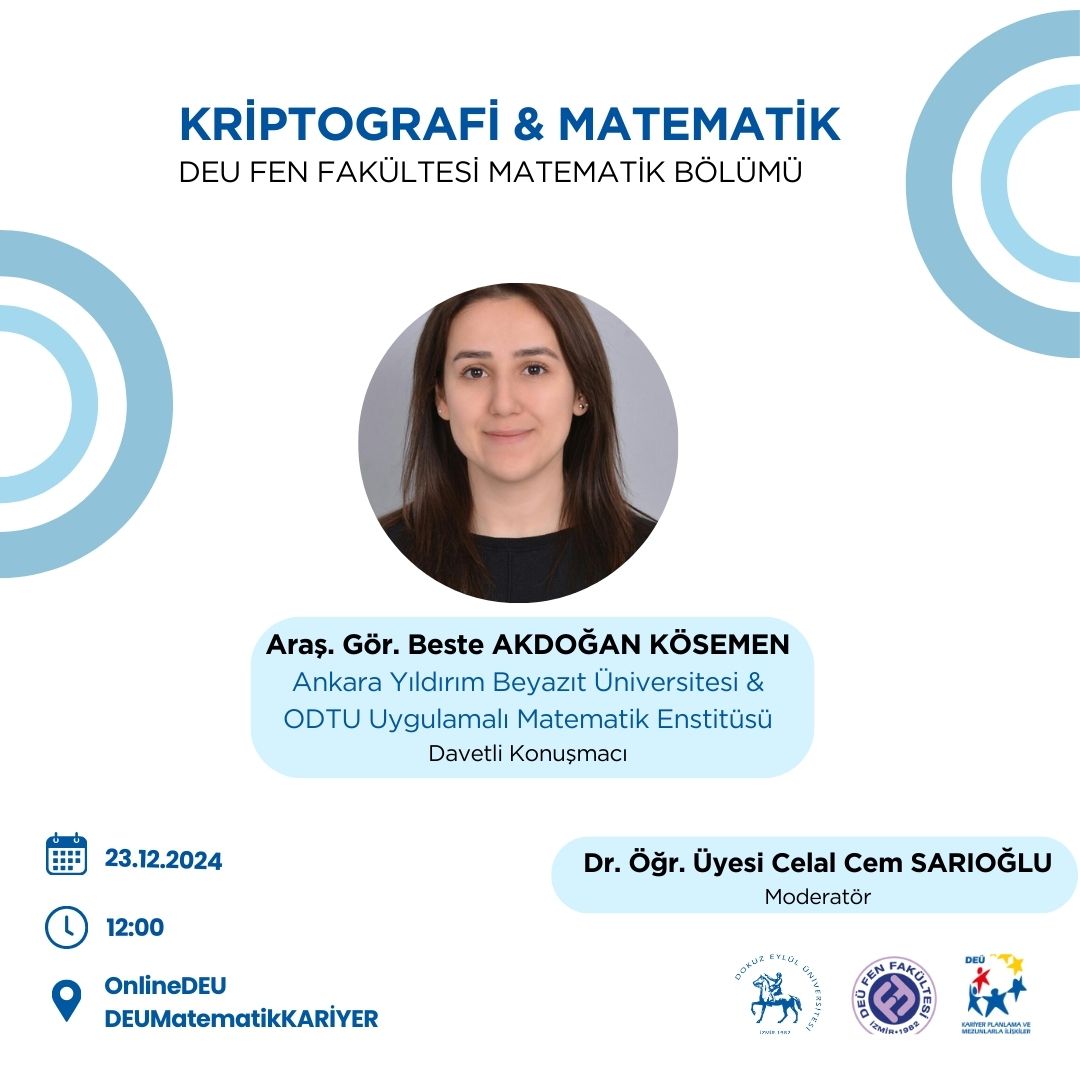
This month’s career event theme is “Cryptography and Mathematics”. We are pleased to host a talk on this subject with Beste AKDOĞAN KÖSEMEN, a 2016 graduate of our department and currently pursuing her Ph.D. in Cryptography at METU Institute of Applied Mathematics. The event is open to all mathematics department students and anyone interested. (Non-mathematics department participants are kindly requested to contact the moderator for attendance.)

Speaker: Res. Asst. Beste AKDOĞAN KÖSEMEN (Ankara Yıldırım Beyazıt University, Mathematics Department & METU Institute of Applied Mathematics)
Topic: Mathematics and Cryptography
Date & Time: December 23, 2024, 12:00 PM
Venue: online.deu.edu.tr
Channel: DEUMatematikKARİYER
Moderator: Asst.Prof.Dr. Celal Cem SARIOĞLU


From Mathematics to Codes: Shaping the Future with Artificial Intelligence

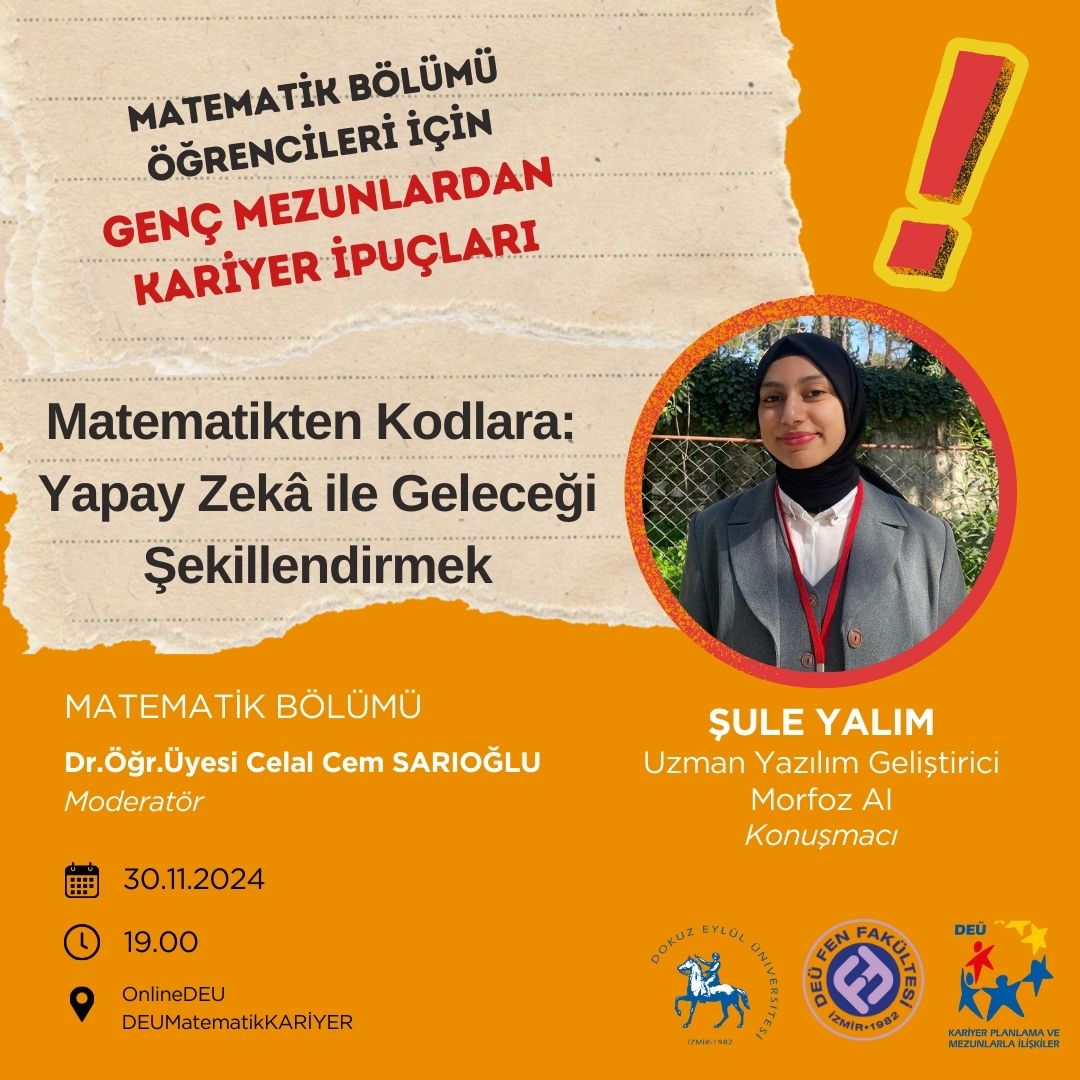
The theme of our career event this month, organized by DEU Faculty of Science, Department of Mathematics in collaboration with DEU Career Planning Center, is “Career Tips from Young Graduates”. Everyone interested in the talk titled “From Mathematics to Codes: Shaping the Future with Artificial Intelligence”, which we will hold with our 2024 graduate of the Department of Mathematics “Şule YALIM”, who works as an expert software developer at Morfoz AI, is invited. (Participants other than students of the Department of Mathematics are kindly requested to contact the moderator for event participation.)

Speaker: Şule YALIM (DEU Mathematics 2024 Graduate / Morfoz AI, Expert Software Developer)
Moderator: Asst. Prof. Dr.  Celal Cem SARIOĞLU
Date and Time: 30.11.2024, 19:00
Place: online.deu.edu.tr
Chanel: DEUMatematikKARİYER

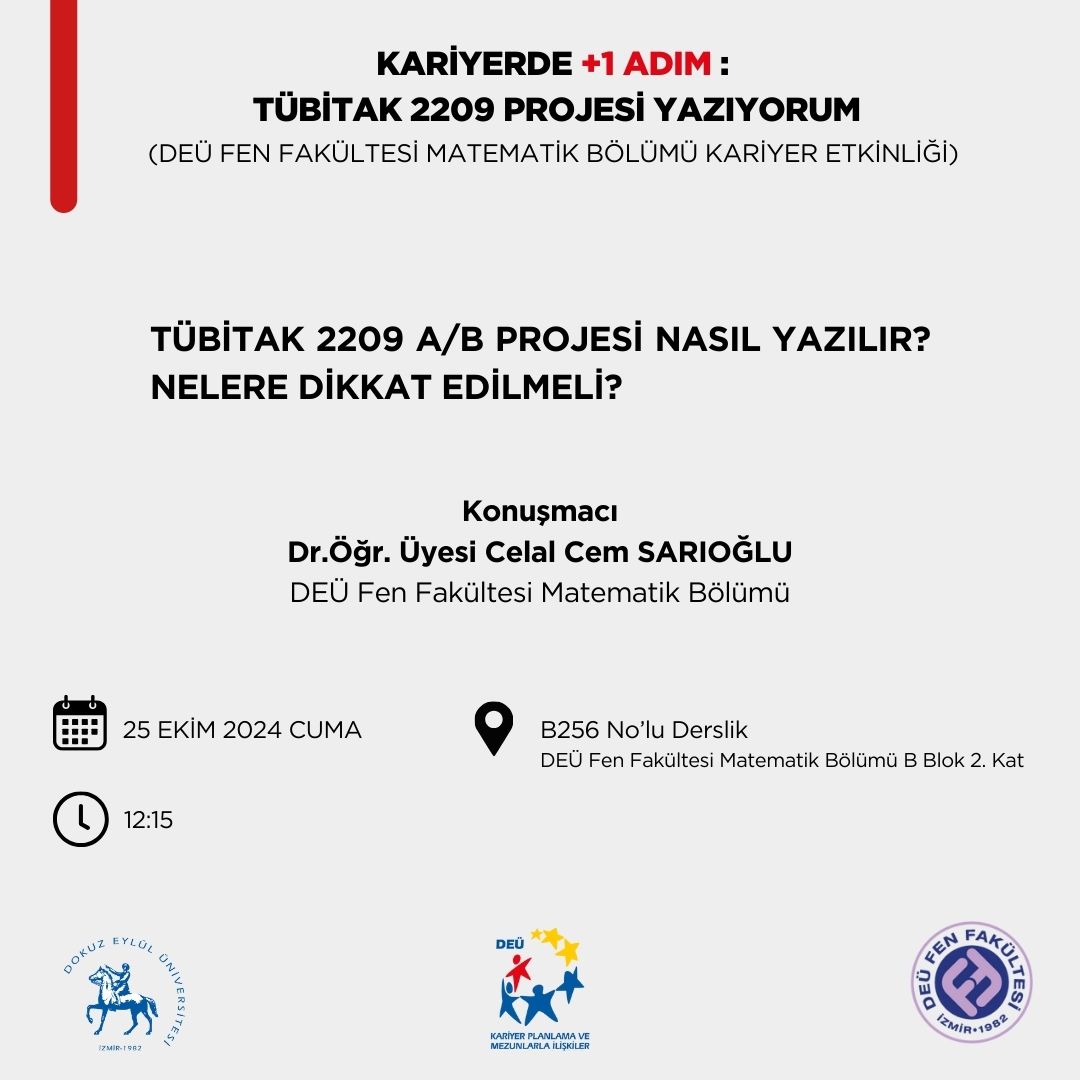
How to Write a TUBITAK 2209 A/B Project? What Should be Considered?

The theme of our career event this month is “+1 Step in Career: I am Writing a TÜBİTAK 2209 Project”. In our event, information will be given about TÜBİTAK 2209 University Student Research Projects and a conversation will be held on the points to be considered when writing a project. The event is open to all mathematics department students and those who are interested.

Speaker: Dr. Öğr. Üyesi Celal Cem SARIOĞLU
Date and Time: 25.10.2024, 12:15
Place: B256 (DEU Faculty of Science, Department of Mathematics)


2024 – 2025 Foreign Language Proficiency Exams

Foreign language exemption exams will be held by the Directorate of the School of Foreign Languages ​​on September 3-4, 2024, for students who are newly registered to undergraduate programs whose language of instruction is completely or partially in a foreign language in the 2024-2025 academic year (including international students), students who failed the preparatory education the year before, and students who will optionally study in a foreign language. Students who will receive compulsory and optional preparatory education are required to take this exam.

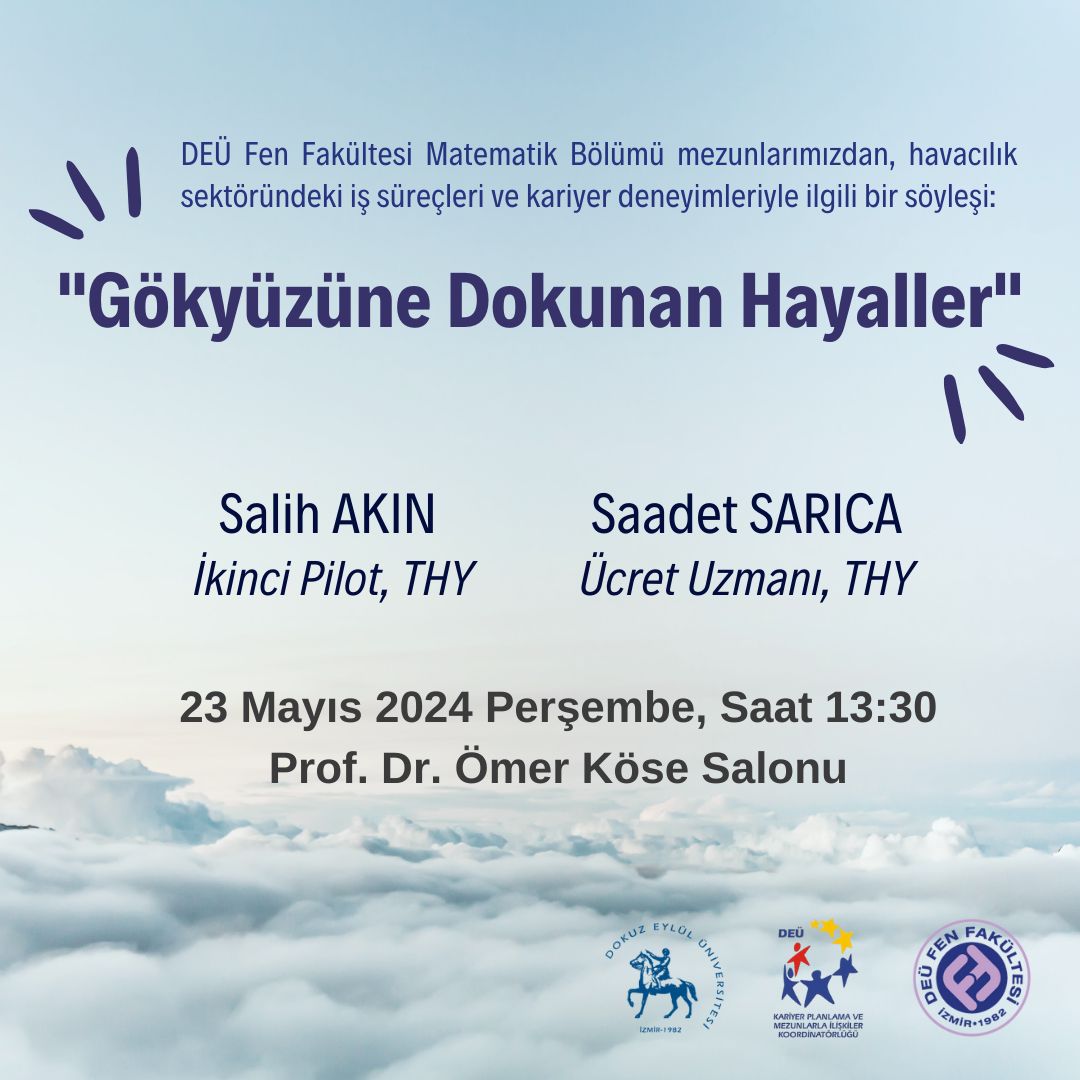
Dreams That Touch the Sky

Salih AKIN, Second Pilot at THY (graduated from DEU, Faculty of Science, Department of Mathematics)

Saadet SARICA, THY Cargo Marketing Directorate, Fare Specialist at the Fare Department (graduated from DEU, Faculty of Science, Department of Mathematics)

Date: Thursday, May 23, 2024

Time: 13:30

Location: DEÜ, Faculty of Science, B block, Prof. Dr. Ömer Köse Conference Hall

Summary: In this event, we will share my business processes and career experiences in the aviation industry.


Hydroelastic waves propagating in ice-covered channel

Prof. Dr. Tatyana Khabakhpasheva, School of Mathematics, University of East Anglia, Norwich/United Kingdom

Date: May 24, 2024, Friday

Time: 14:00 am

Place: B255, Faculty of Science, Dokuz Eylül University

Abstract: Characteristics of linear hydroelastic waves propagating in an ice channel are investigated. The channel is of rectangular cross section with finite depth and of infinite extent. Liquid in the channel is inviscid and incompressible. The liquid flow caused by the ice deflection is potential. The ice is modeled by a thin elastic plate. The coupled hydroelastic problem is reduced to the problem of the wave profiles across the channel. The wave profiles are sought as series of normal dry modes of the plate, coefficients of which are to be determined. Dispersion relations of these hydroelastic waves, their critical speeds, and corresponding strain and stress distributions in the plate are determined. Several special cases in which boundary conditions, ice thickness distributions across the channel width, and ice plate compression were changed were investigated and compared with each other.

Coupled/decoupled linear/nonlinear responses of ice cover to external loads

Prof. Dr. Alexander Korobkin, School of Mathematics, University of East Anglia, Norwich/United Kingdom

Date: May 24, 2024, Friday

Time: 13:00 am

Place: B255, Faculty of Science, Dokuz Eylül University

Abstract: Modelling response of an elastic floating plate to a body moving under the plate is discussed. The original problem is nonlinear and coupled with the plate deflection being dependent on the hydrodynamic pressure, which in turn depends on the plate deflection. It is shown that the problem can be treated as decoupled for some conditions of the body motion, which significantly simplifies the analysis. Within the decoupled model, the body motion and the hydrodynamic pressure along the plate/water interface are calculated without account for the plate deflection. Then this pressure is applied to the equations of the plate dynamics without account for the fluid response to the plate deflection. It is known that only rather small strains are allowed in ice plates, which limits the deflections of the ice and importance of the nonlinear effects. It is shown that nonlinear effects in problems of hydroelastic response of floating ice sheets can be approximately neglected in many practical situations.

On the Edge Cover Polynomial Properties of Certain Graph Families

Prof. Dr. Feryal Alayont, Mathematics at Grand Valley State University

Date: May 16, 2024, Thursday

Time: 11:00 am

Place: B257, Faculty of Science, Dokuz Eylül University

Abstract: An edge cover of a simple graph is a subset of the edges so that each vertex is incident with at least one edge in the subset. The edge cover polynomial of a graph is the generating polynomial of the number of edge covers of the graph. Specifically, the edge cover polynomial is defined as where is the number of edge covers with edges. The edge cover polynomials of path and cycle graphs are known to have real roots, and hence have log-concave and unimodal coefficients. In this talk, we will describe how to construct other graph families whose edge cover polynomials have real roots and some whose polynomials have non-real roots, but still have log- concave and unimodal coefficients. This is joint work with Evan Henning and Can Selek.

Feryal Alayont is a Professor of Mathematics at Grand Valley State University. She received her B.S. in mathematics from Bilkent University, Turkey, and her Ph.D. in mathematics from the University of Minnesota. She was a teaching postdoctoral fellow at the University of Arizona from 2003 to 2006. Since 2006, she has been at Grand Valley State University in the Department of Mathematics, where she also served as the Mathematics Advising and Engagement Coordinator from 2016-2022. She is an active undergraduate research mentor and has mentored more than 75 students at GVSU. Her research interests include enumerative combinatorics, graph theory, ethics in mathematics, and the scholarship of teaching of mathematics.