
Program_Duyuru
undergraduate-research
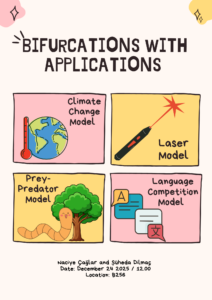
Student Seminar: Bifurcations with Applications
Abstract: Last spring, we gave a presentation on chaos theory, where we discussed many concepts within the scope of the theory. In this presentation, we aim to explore the behavior of dynamical systems through examples drawn from everyday life. From changes in the Earth’s climate to predator–prey interactions observed in nature; from the operating principles of lasers to the extinction of languages spoken in the past, we examine these processes from a mathematical perspective. We would be pleased to have you join our presentation.
Date: December 24, 2025 | 12.00 – 13.00
Place: B256
Origami Axioms and Constructible Numbers by Origami
Atakan Özcan and Pınar Ecem Akyıldırım, Dokuz Eylül University.
Date: 4th of December, 2025, Thursday, Time: 15.00 – 16.00.
Place: Dokuz Eylül Univ., Tınaztepe Campus, Faculty of Science, Department of Mathematics, Classroom B255.
Abstract: We will firstly mention straightedge-compass constructions and five axioms for them. By straightedge and compass constructions, we will talk about, drawing lines and circles, constructions of a perpendicular to a given line through a given point, drawing a parallel line to a given line passing through a given point and bisecting an angle. Then we will see basic properties of origami and the Huzita-Hatori seven postulates for origami. Another set of axioms for origami is obtained by just adding another axiom to the five axioms of straightedge-compass constructions. We will show the equivalence between these two sets of axioms for origami. Trisection of an angle is known to be impossible using straightedge and compass constructions, but we will see that it is possible using origami constructions.
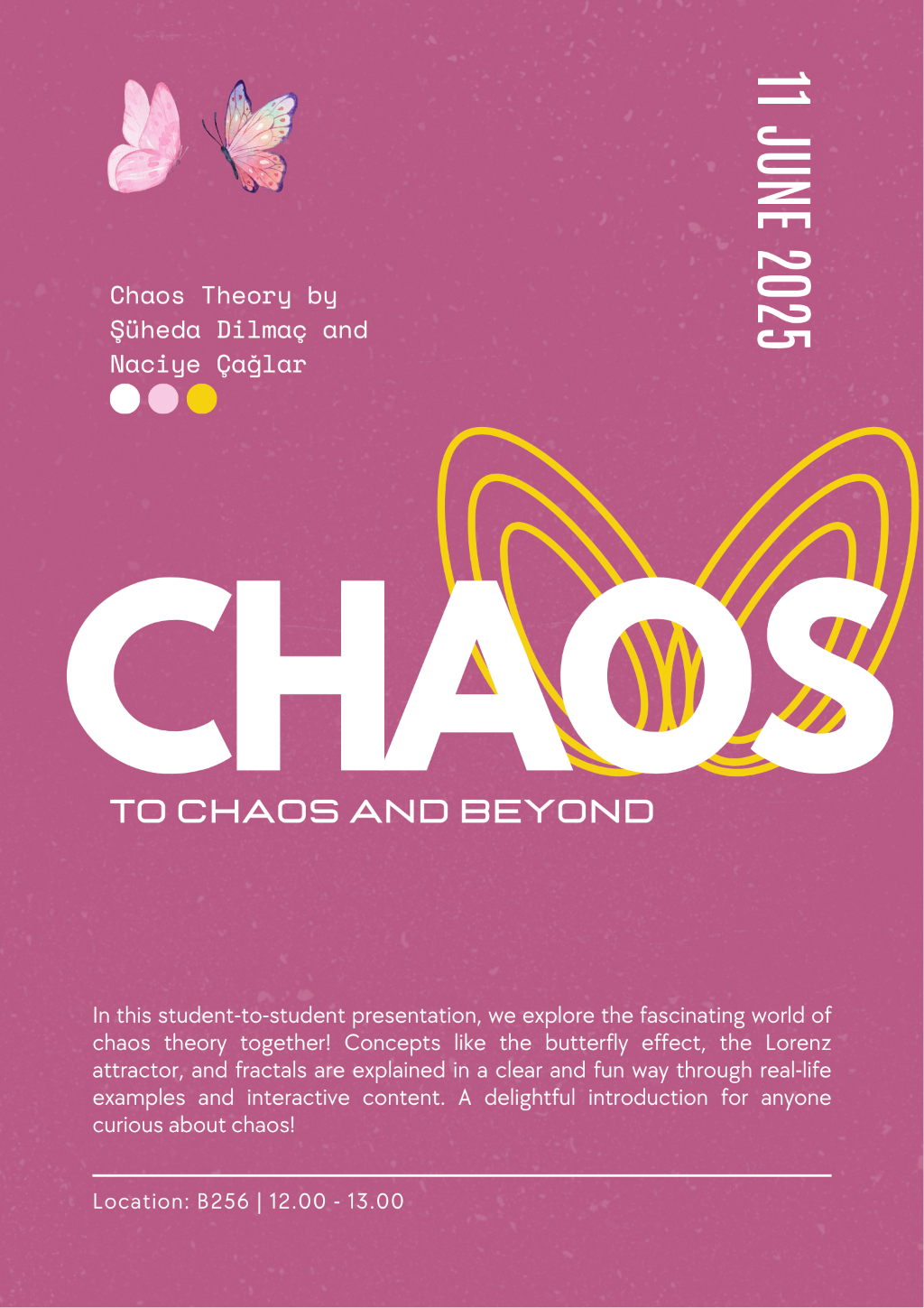
Student Seminar: To Chaos and Beyond
Title: To Chaos and Beyond
Speakers: Şüheda Dilmaç, Naciye Çağlar
Abstract: In this student-to-student presentation, we explore the fascinating world of chaos theory
together! Concepts like the butterfly effect, the Lorenz attractor, and fractals are explained in a
clear and fun way through real-life examples and interactive content. A delightful introduction for
anyone curious about chaos!
Date: June 11, 2025 | 12.00 – 13.00
Location: B256
Fundamental Theorem of Symmetric Polynomials, Newton’s Identities and Discriminants
Mustafa Eren Taşlı, Dokuz Eylül University. Date: 26th of December, 2024, Wednesday, Time: 15.00 – 16.00. Place: Dokuz Eylül Univ., Tınaztepe Campus, Faculty of Science, Department of Mathematics, Classroom B255.
Abstract: We will define symmetric polynomials and the elementary symmetric polynomials in  indeterminates over a field
  . The elementary symmetric polynomials in the indeterminates
  are as follows:

The Fundamental Theorem of Symmetric Polynomials states that any symmetric polynomial can be expressed as a polynomial in the elementary symmetric polynomials, that is:
Theorem. Let  be a symmetric polynomial in the indeterminates over a field . Then, there exists a polynomial
  in the indeterminates
  such that
![\[f(x_1, x_2, \ldots, x_n) = g(\sigma_1, \sigma_2, \ldots, \sigma_n),\]](https://quicklatex.com/cache3/86/ql_7204178dea0bfa639531ef8835e31786_l3.png)
where  are the above elementary symmetric polynomials of the indeterminates . Moreover, the polynomial is uniquely determined.
We will prove this theorem using the graded lexicographic order for multivariable polynomials.
Using the recurrence relation from the Newton Identities, we will learn how to express the sum of powers of the indeterminates, that is, the polyomials
![\[s_k = x_1^k + x_2^k + \ldots + x_n^k\]](https://quicklatex.com/cache3/1c/ql_b3947574d56896a407d99b12cb82c51c_l3.png)
for a positive integer  , as polynomials in terms of the elementary symmetric polynomials. We will reinforce this understanding with examples.
The discriminant in the indeterminates over the field is given by:
![\[\Delta = \prod_{1 \leq i < j \leq n} (x_i - x_j)^2 \in F[x_1, \dots, x_n].\]](https://quicklatex.com/cache3/43/ql_682efe13d812226573dc8652daa38243_l3.png)
The discriminant is a symmetric polynomial, and we will express it in terms of the elementary symmetric polynomials using determinants.
This seminar, as part of my graduation project titled Symmetric Polynomials, Newton’s Identities, Discriminants, and Resultants, serves as an introduction to a method for calculating the discriminant ( ) of an -th degree polynomial without finding its roots.
Cardano’s Formula and Casus Irreducibilis
Çağdaş Çiğdemoğlu, Dokuz Eylül University. Date: 18th of December, 2024, Wednesday, Time: 15.00 – 16.00. Place: Dokuz Eylül Univ., Tınaztepe Campus, Faculty of Science, Department of Mathematics, Classroom B255.
Abstract: We will start with a general monic cubic equation in the form
![\[ x^3 + bx^2 + cx + d = 0, \]](https://quicklatex.com/cache3/6a/ql_2e2f8cd84c4ce76efb7fb9b06206566a_l3.png)
and transform it into the following form
![\[ y^3 + py + q = 0, \]](https://quicklatex.com/cache3/bf/ql_0d8db80131ada767debc90a3981a2fbf_l3.png)
using a substitution. Then, we will construct the Cardano Formulas to find the roots of the equation. The roots are expressed as follows:
![\[ y_1 = \sqrt[3]{\frac{-q + \sqrt{q^2 + \frac{4p^3}{27}}}{2}} + \sqrt[3]{\frac{-q - \sqrt{q^2 + \frac{4p^3}{27}}}{2}}, \]](https://quicklatex.com/cache3/46/ql_b0a5d9db041094f1b16bdb2e8028ef46_l3.png)
![\[ y_2 = \omega \sqrt[3]{\frac{-q + \sqrt{q^2 + \frac{4p^3}{27}}}{2}} + \omega^2 \sqrt[3]{\frac{-q - \sqrt{q^2 + \frac{4p^3}{27}}}{2}}, \]](https://quicklatex.com/cache3/71/ql_a0584521c6ef0017ae10d8afff37fe71_l3.png)
![\[ y_3 = \omega^2 \sqrt[3]{\frac{-q + \sqrt{q^2 + \frac{4p^3}{27}}}{2}} + \omega \sqrt[3]{\frac{-q - \sqrt{q^2 + \frac{4p^3}{27}}}{2}}, \]](https://quicklatex.com/cache3/97/ql_2bb3ced4987531f3ba5c2ff53bea4d97_l3.png)
where  is a primitive cube root of unity and where the above cube roots are one of the three complex cube roots whose product is
  and these are fixed in the above formulas.
We will learn about the discriminant of the above monic cubic polynomial, understand its significance, and examine how the roots change depending on the value of the discriminant.
For the monic cubic polynomial in the form  , the discriminant is expressed by:
![\[ \Delta = -27q^2 - 4p^3 = (y_1-y_2)^2(y_1-y_3)^2(y_2-y_3)^2. \]](https://quicklatex.com/cache3/46/ql_d93829faf28fbe23838ebf1bbf44b746_l3.png)
For the general monic cubic polynomial  , whose roots are
  , the discriminant is expressed by:
![\[ \Delta = b^2c^2 + 18bcd - 4c^3 - 4b^3d - 27d^2 = (x_1-x_2)^2(x_1-x_3)^2(x_2-x_3)^2. \]](https://quicklatex.com/cache3/04/ql_e7e22903bb3446549f52a74c9bcd9604_l3.png)
We will also discuss Casus Irreducibilis, which occurs when the coefficients  (or
(or  ) are in a subfield of of
  , the cubic polynomial is irreducible over (equivalently, the cubic equation has no roots in ) and when the discriminant is positive. In this case, the cubic equation has three distinct real roots that cannot be expressed using real radicals.
This seminar serves as an introduction to my project, which focuses on understanding the proof of Casus Irreducibilis using Galois Theory.
Cardano's Formula and Casus Irreducibilis